…my true love gave to me: a card with a greeting merry!
For the second year in a row, I signed up for the Christmas Card swap on Lettuce Craft, because who doesn’t like getting a little festive mail? Or mail in general, really?
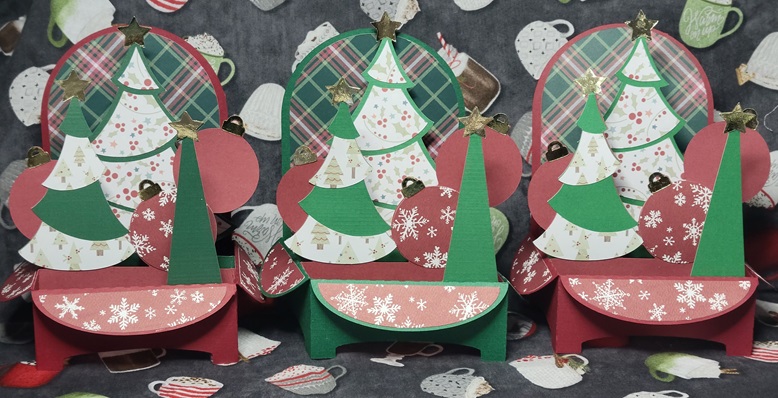
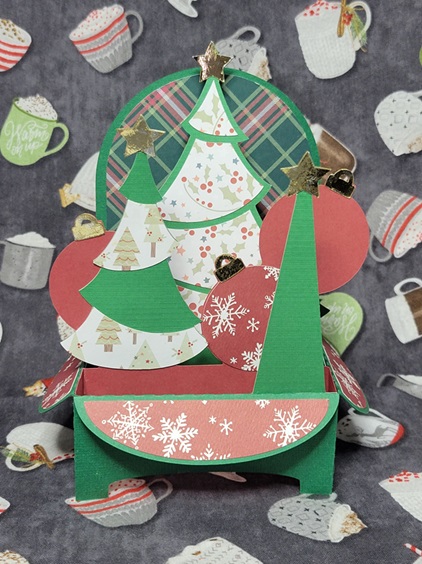
Last year, I kept things fairly simple with a bit of embossing powder and die-cut messages (trust me, it’s simpler than it might sound), but this year I apparently lost all sense of reason when I saw the Christmas Trees box card on SVGCuts. This had presence, drama, and a great reason to play with some fun patterned papers that mysteriously find their way into one’s stash but don’t get used for being “too busy”.
Speaking of patterned papers: trying to decide on a colour scheme was pretty much impossible. In the end, I made three cards in a traditional red-and-green theme, and the other three using fun mid-century pinks and teals. The traditional set got gold stars and ornament hangers, and I used silver for the mid-century set. I stamped the back of each card with a fun, festive message that still left plenty of room to sign. The pattern came with a little train to attach to the inside front of the card, but I left it out to make things all about the trees.
I wouldn’t say that making six 3D cards was a mistake, but it sure was an undertaking. The actual assembly wasn’t so bad – I hit upon a rhythm and system that got me down to about 30 minutes of gluing and positioning per card – but cutting out all the different pieces and keeping them sorted until I could put them together was a challenge. I started by making little piles for each card, starting with the solid coloured base and then setting subsequent stars, tree bits, etc. on top, and then putting each little group into its own envelope to wait patiently to be glued together.
The other challenge came when it was time to mail them. When folded flat, they’re 7 inches square (or as square as you can be with irregular edges), which is bigger than most envelope sizes commonly found in stores. Sure, there are 9″ x 12″ envelopes for letter-sized paper, but that felt like overkill. I found some 7.5″ x 10″ “catalogue envelopes” at Staples which fit the bill nicely. And then…I worried that they would get bent in the mail, so I made little cardboard sleeves to give them a bit of stiffness. Some people helicopter-parent their kids; I do it to my crafts.
Luckily, my over-packaging seems to have worked: four out of six partners have received them so far, and they’re standing just as straight as they did before mailing.
…my true love gave to me: some Grinchy little guys for the tree!
In unpacking the Christmas decorations this year, I came to the realization that wow, there were a lot of cross-stitched pieces in there, and I might have a problem. There were cross-stitched representations of the cats, typographical hoops, and a whole bunch of ornaments stitched on perforated paper. (And that’s not counting the older ones, stitched on flexible vinyl Aida, that are blocky and weird by contemporary design standards.)
Of course, even if I had (re)discovered this sooner, it likely wouldn’t have stopped me from working up these guys. I had had the pattern in my Etsy favourites for a long time, and finally had the chance to stitch it.
Because the design is so small, and because my Q-snaps are…not that small, it was easier to cut a piece of fabric (iridescent Aida for the win!) large enough to accommodate three repeats of the pattern than to struggle and curse a piece sized for one. I folded the strip into thirds, found the centre of each third, and set to stitchin’.
When they were done I washed and pressed the whole big piece, then cut the thirds apart and mounted each one in a 3″ wooden hoop. I had briefly debated painting the hoops somehow (or maybe spray them with glitter spray paint) but thought the understated look worked well for someone who stole Christmas before promptly returning it. He’s definitely adopted a pre-epiphany stance here.
A friend has called dibs on one, and I’ll be keeping one, leaving me with an extra to hang somewhere or keep up my sleeve as a crafty add-on to a gift.
Ever since I first started playing around with heat transfer vinyl, the idea of doing multi-coloured/layered designs was always in the back of my mind. Like so many other things that live back there for “some day”, this was dismissed as being too complicated, and what if it didn’t work? That would be a waste of perfectly good vinyl!
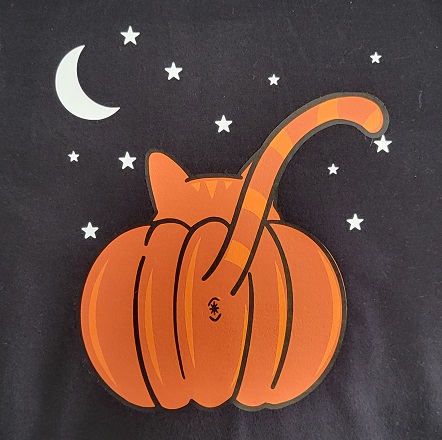
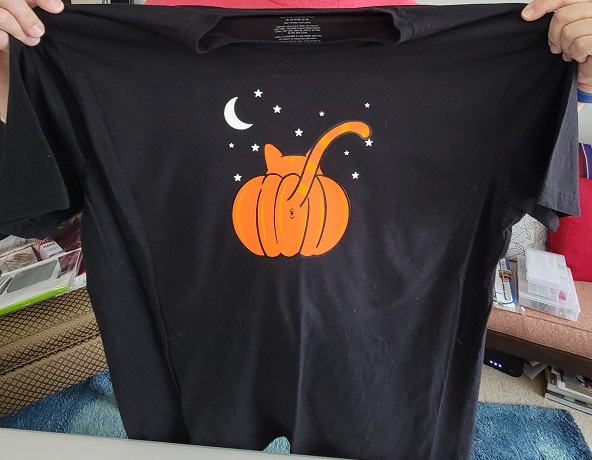
I was finally spurred into action when I saw this hoodie on Modcloth. So cute! So cat-iful! The price was a bit hard to swallow, though. And once the price caught in my throat, I found other reasons to not buy it: with the graphic on the back, people might not be able to see and appreciate it to the full extent possible; they only had a handful of sizes left and were still asking nearly-full price; that’s still a crazy amount of money for a hoodie that’s got a strong seasonal vibe.
An Etsy search turned up the exact same image as an SVG file for a fraction of the price. (Note: searching for “pumpkin butt” generates a lot of hits for kits to, ahem, paint your infant’s backside orange and turn the resulting print into a pumpkin. Shudder. “Cat butt pumpkin” was a lot more helpful.) I gleefully informed my Crafting Buddy (who is also my Baking Buddy) that I had found our layered vinyl project. He said he wasn’t sure that he’d want a big pumpkin cat butt on the front of his shirt…”but I could see it as a smaller image on the chest, maybe”. Back to my search, where I found something appropriately pop-culture and masculine for his Halloween finery. Once I got the images resized appropriately, I cut out one colour/layer at a time and hoped against hope this would work.
We started with his shirt because the pieces were a bit smaller and easier to wrangle.
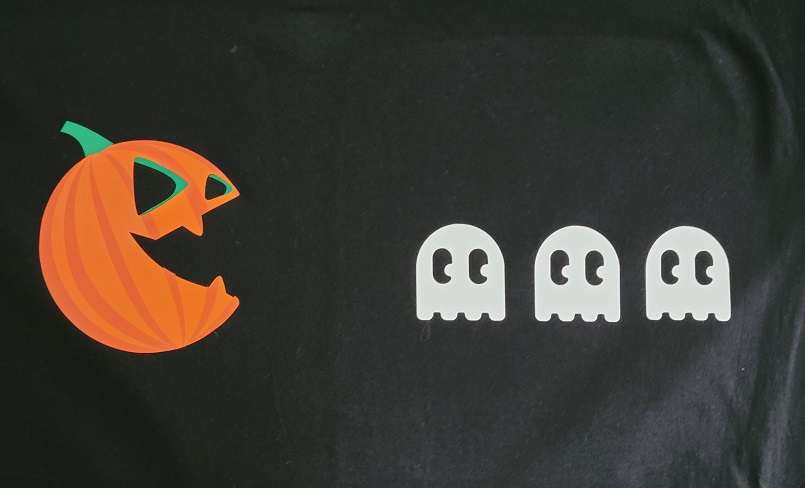
This is the back side i.e. the part that gets placed against the shirt. I learned an invaluable lesson: if you’re going to weed everything ahead of time, make sure you have wax paper or something similar between your pieces, or else the carrier sheet will stick to the sheet immediately below and maybe even start peeling the vinyl off.
We started by dry-fitting (cold-fitting, sine this was before heat pressing?) the pieces to see how they would look.
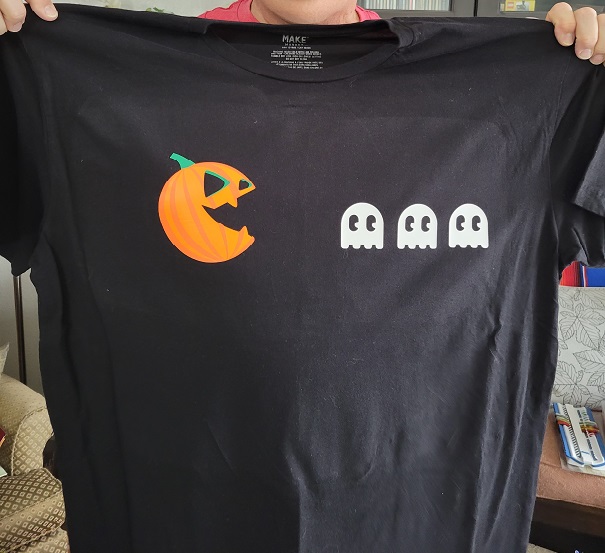
It took some careful placement, but we got the remaining two layers of the pumpkin lined up. The ghosts should probably be a little bit closer to the pumpkin, but we moved them over to centre the design overall.
It looks pretty good! (The colour variance you’re seeing in the black is just from the heat press, and isn’t a permanent feature.)
Once we had one under our belts, we assembled my shirt. It was slightly more awkward because of the larger pieces of vinyl.
We got things lined up pretty well, though!
Now we can check “layered vinyl” off our crafty bucket list. I don’t know how often I’ll do it, but it’s a nice trick to have up my sleeve.
Is anyone else noticing a proliferation of celestial-themed everything out there lately? When I was in high school, that kind of stuff was everywhere, and I’m pretty sure my mom still has the moon-and-stars ironing board cover I picked out for her. I’d like to think I’ve matured since high school: I don’t plan my days based on my horoscope, have stopped following those “get this gift for the person in your life with that zodiac sign” guides that were a staple of every November or December issue of Seventeen and YM, and only use “Mercury is in retrograde” ironically. Lo, the fully-functioning adult, basing her life on fact rather than vague character descriptions.
All of that newfound maturity and composure was out the window when a zodiac swap was being planned on Lettuce Craft a few months back. As luck would have it, I had just finished a large-ish crafty commitment, and my fingers were itching for a new project. Surely this was written in the stars! Or…not. Due to a lack of interest, the official swap got cancelled, but the only other would-be participant reached out and asked if I was interested in doing a personal swap with her. Ooh! This was written in the stars!
My partner was a Capricorn. I’ve had a lot of Sagittariuses (Sagittarii?) in my life, but the only Capricorn I grew up with was my best friend from Gr. 3 – 10, and she just didn’t embrace the whole astrology thing. After doing a bit of online research, I was pretty well-versed in traits, colours, everything. And although we were only supposed to make one item, I wound up making two. It happened like this…
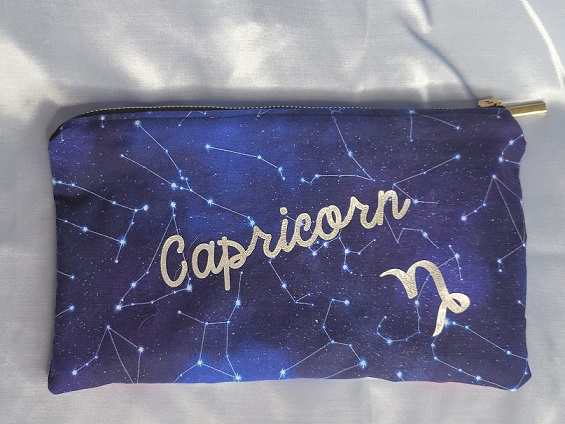
When we first exchanged questionnaires, one of my partner’s “wish” items was a zipper pouch. I was psyched, because even my rudimentary sewing skills should have been able to handle that. She went on to say she liked bright colours, as well as earth tones, but “not too much pink”.
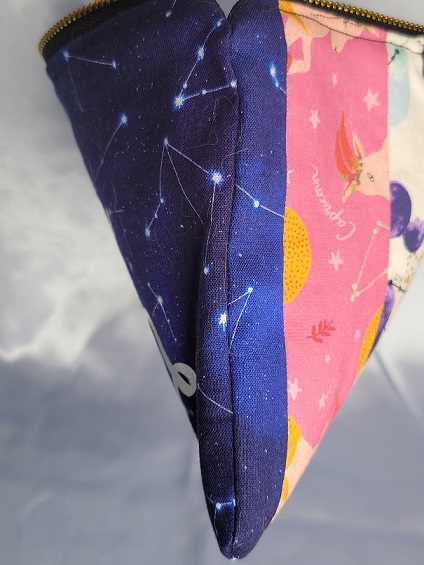
When I got to the fabric store (any excuse for a trip there!) and found the section housing appropriately astrological prints, the designated Capricorn print was pink. Of course. That didn’t stop me buying a bit of it, as well as varying cuts of a few other prints. Nothing said I had to use the pink fabric for the entire pouch, right? Maybe I could combine them somehow. Sewing is one thing, but I’m not a quilter, a planner-of-attaching-pieces-to-other-pieces. I let my fabrics languish for a while (this is very much the approach I took to my t-shirt quilt, albeit over a shorter time frame), and started cruising the internet again.
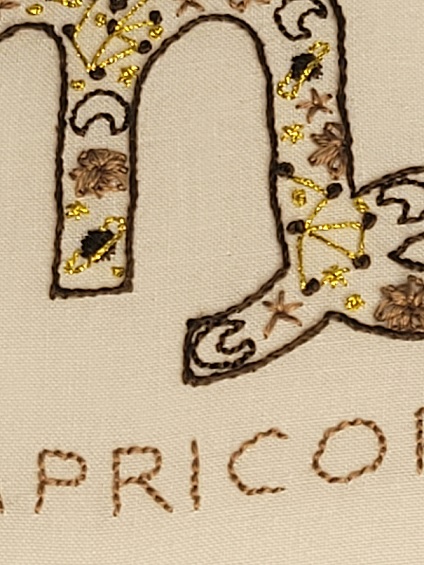
Etsy saved the day with this fun embroidery pattern. Finally, something right in my wheelhouse! I wasted no time in downloading the PDF and transferring it to some Kona cotton I had bought a few years ago for the sole purpose of embroidering. The only thing I did a little differently was changing up the order of the stitches from what the accompanying guide recommended: the outline of the symbol was one of the first parts stitched in the guide, but I left it until the very end to ensure no other stitches (looking at you, lazy daisies!) would breach the edge of the design.
This was a complete joy to stitch. The pattern and colours were something I would normally never have done for myself or others in my immediate circle, and yet they worked together so well.
That still left the issue of my zip pouch. I found a zipper I liked and measured its length to determine how wide my fabric would need to be. From there, I cut strips of three different fabrics and sewed them into one big rectangle. Fun fact: despite much calculating on my part, my Franken-rectangle turned out to be longer than the zipper – still, better too long than too short, right? That’s what scissors are for! I decided the other side didn’t need to be as busy, and used just a single fabric for it, making sure it was the same as the outside strips on the other side to allow for some continuity at the side seam.
I cut out the word “Capricorn” and its symbol using the Silhouette and some metallic silver heat transfer vinyl just to stop the other side from being completely plain and positioned it at an angle for visual interest.
Oh, and used some elegant moon-phase fabric for the lining.
My partner said she loved everything, and I’m pretty sure my sigh of relief was heard around the world. Between reliving my horoscope-obsessed high school days and crafting something just a little bit out of my comfort zone, this was a really fun swap.
Hard to believe, isn’t it? On August 21, 2008 I hit the “Publish” button on my very first post. I wanted to post something fun to commemorate the occasion, so here is the UFO to end all UFO’s.
Many, many years ago, three things happened in glorious synchronicity. I was the thinnest I had been in my life. I had a job with an extremely casual dress code. And (it’s impossible to overstate this) graphic t-shirts were seemingly everywhere. They’ve been around forever, I know, but suddenly there were swaths of them. This resulted in my amassing a collection to rival the local stores and turning a t-shirt and flared jeans into my de facto uniform.
Times change, though, and I moved on to a job that made us dress like we were in an office. T-shirts were still weekend wear, but some of them got a little small. Some new ones came into the closet, jockeying for space with the old ones. I’m a sentimentalist with a memory for detail, and couldn’t just get rid of most of them – they all had a story! I had seen t-shirt quilts in craft books before, but that felt like a really big project. (One of them assumed the crafter might not have enough t-shirts and provided instructions for using ink-jet transfer paper to create their own specifically for the purpose of cutting them up to sew.) Still, the idea was intriguing, and I started pulling shirts from my collection and setting them aside.
Reader, I gathered 30 in all. 30! I had no idea I owned that many, or at least, I was subconsciously repressing that knowledge.
Now, where was I? Oh, yes. I pulled the shirts, arranged them in a quasi-rainbow to get a feel for the balance of colours, and promptly ignored them for…a while. What was I supposed to do with them? Where should I start? This is what I get for picking a project that didn’t come with its own pattern.
Eventually, I decided squares would be easiest. I got a 12″ square peel-and-stick floor tile from the hardware store (genius!) and used that as a template, centring it on my shirts and then running the rotary cutter around it. This method meant that I actually got two 12-inch squares from each shirt – front and back – and for a brief moment I considered assembling the plain back squares into the backing of the quilt. Thank goodness I didn’t, because I’d probably still be sewing it today. The upside is, I now have 30 ultra-soft 12-inch cleaning cloths as a nice eco-friendly alternative to paper towels. I arranged and rearranged my 30 front squares until I had a 5 x 6 grid I was happy with. I took a picture for future reference (still more genius!), and then…ignored them for a while. Yes, there’s absolutely a trend developing here.
I knew I wanted a non-stretchy fabric in between my squares to prevent, well, stretching and distortion later on, and picked up some inexpensive solid-coloured flannelette that fit the bill nicely. I cut strips 12″ long by 2″ wide out of blue flannelette, and cut 2″ squares out of pink to go at the “intersections”. I didn’t think to take any pictures of this, but I did ignore it for a while after getting my pieces cut out.
When I was ready to assemble, I started making horizontal rows of five shirts, with a 12″ x 2″ strip between each one (for a total of four blue strips per row). Does anybody want to hazard a guess as to what happened? That’s right – I sewed “filler” rows of five blue strips with four pink squares in between, to eventually go in between the t-shirt rows…and then I ignored them for a while.
It might sound like there was a lot of ignoring going on, and while that’s true to a degree, I’m grateful this wasn’t the kind of project that had to sit out in the middle of the floor or dining room table while it was being ignored. In fact, it was something that could be sewn in steps and would have been a reasonably quick project were it not for the stashing away and ignoring.
Somehow, I managed not to lose any of my rows (t-shirt or straight flannelette), and slowly…painfully slowly…would pin and sew on a row at a time here and there, as the mood struck me. The rows were about five feet long, less seam allowances but plus flannelette strips, and needed to be laid out carefully on the floor for pinning. I had to be mindful not to stretch any of the t-shirt squares (although it did happen, at least a little bit), and found it was easiest to start by lining up my pink squares in the filler rows with the blue strips in my t-shirt rows. Once I had done that, I just had to keep the t-shirt and the corresponding blue strip lined up.
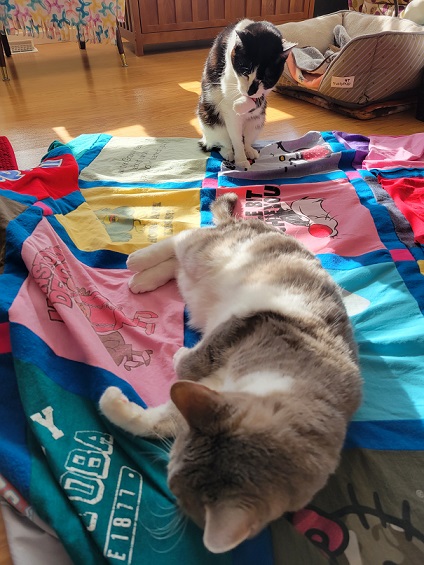
Sometimes, I had help!
At long last, all six t-shirt rows and five filler rows were sewn together into one big piece that actually looked like it was supposed to. A traditional quilt includes a layer of batting in the middle and then a backing, but I’m not a traditional quilter. I bought some pink fleece for my back, figuring it could do double duty as the warm and snuggly part, too. I cut it to size and then lined it up with my quilt top (wrong sides together) and ran a zig-zag stitch all the way around to hold the layers together before adding my binding, which I also attached with a zig-zag stitch.
The other thing I didn’t do that might shock quilters is…I didn’t quilt it. I had weighed the merits of “stitch in the ditch” around my pink squares vs. going old-school and tying yarn through my layers at strategic points, and then decided against both. There’s no batting inside to move around and bunch up in one corner, and the fleece tends to stick a bit and stay put, so once this baby was bound, it was done.
My old photo ID for work featured me in this shirt:
In all, it took me just shy of nine years from the initial pulling of shirts until the final stitch. When I said UFO, I meant it! But oh my stars, was it ever worth it. It’s the perfect weight for a summer cover instead of my comforter, soft and snuggly without being too heavy. It would probably make a great picnic blanket, but I will not be risking grass stains after how long it took to get it finished. In the time since I first started gathering my shirts for this project, I’ve easily acquired that many again (and probably more)…so who knows; there may be another, hopefully quicker, t-shirt quilt in my future.
For my mom’s birthday, I wanted to have at least one homemade component. I wound up with several: a card, a nifty poochie-style bag to hold her swag, an altered Altoids tin meant to hold a gift card, and these fingerless gloves.
Or is that fingerless mittens? Generally the defining characteristic of gloves is that they have, well, fingers. In any case: something meant to help keep her hands warm while affording her dexterity.
I found the pattern in some sort of “Autumn Crochet” magazine I had picked up for myself, and luckily had one of her favourite colours in my stash, so it was meant to be.
(Please excuse the Enid Sinclair-inspired nails.)
Isn’t that purple something? It’s called “Amethyst”, and I think it pops even more in real life.
What was really cool was how the gloves were constructed. The ribbing comes first, created by rows of back-loop-only stitches, then you stitch the ends together to create a tube, give the works a 90-degree turn right here:
…and start your rounds to form the upper part. It’s all done as one piece and doesn’t come off your hook until you have a fully-formed glove. Pretty neat, eh? I’m especially proud of the fact that I kept my tension even enough to produce two the same size. 😉
It’s still a little bit cold out for her to wear them, but these will be just the thing once spring starts springing and she needs just a little coverage.
…my true love gave to me: a night known for being starry!
Earlier this year (or maybe late last year?), I read about a shop called CrossStitchObsession that produces charts of miniaturized works of art in cross-stitch form. The picture the article featured included a tiny version of van Gogh’s The Starry Night, and one of my nearest and dearest particularly admires that painting. This was a stocking stuffer just waiting to stuff!
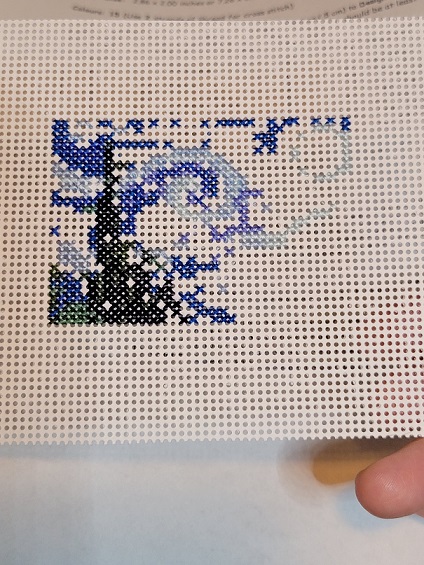
I had my doubts when I first started – it really didn’t look like too much.
Gradually, though, a picture began to emerge.
Before long, anyone would have been able to recognize it!
It actually got harder to do the further I got! I’m not one for marking up charts to cross out what I’ve already stitched, and without that, trying to match up the blank spots on the perforated paper to the chart became quite the trick. There are so many shades of blue in this, and they all started to look alike after a while.
I backed it with some navy blue cardstock to give it a little sturdiness. The mini easel was one of those miraculous Michaels finds. They came in a pack of four, so I might have to stitch a few more mini masterpieces.
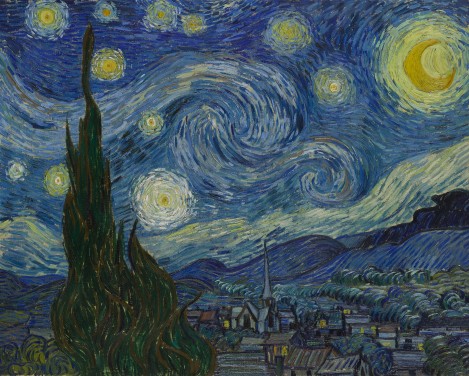
For comparison, here’s the original painting (image courtesy of the MoMA website):
That the designer(s) got that much detail into a 2″ x 3″ pattern is simply astounding. I’m so excited for him to unwrap it on Christmas!
…my true love gave to me: two turtle doves and a partridge in a pear tree!
“Wait, wait, that’s not how this works! You’re just supposed to use the format of the song to talk about what you’ve made, not rip it off word-for-word. You know better than that! Now, what did you actually make? OK…two…turtledoves and…a partridge in a pear tree? Really? Uh, carry on, then, I guess.”
I don’t collect much anymore. Sure, my tsundoku spiralled out of control during the pandemic, but books don’t count, right? One soft spot I have, though, is cross-stitched interpretations of “The 12 Days of Christmas”. I’ve probably got no fewer than six or eight different patterns, not to be stitched (yet!), but to be admired and the possibilities dreamt of.
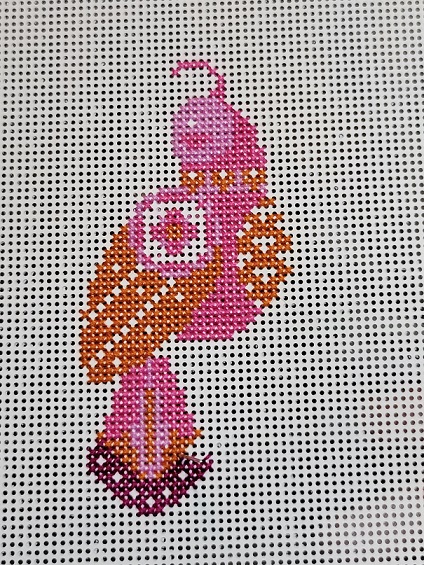
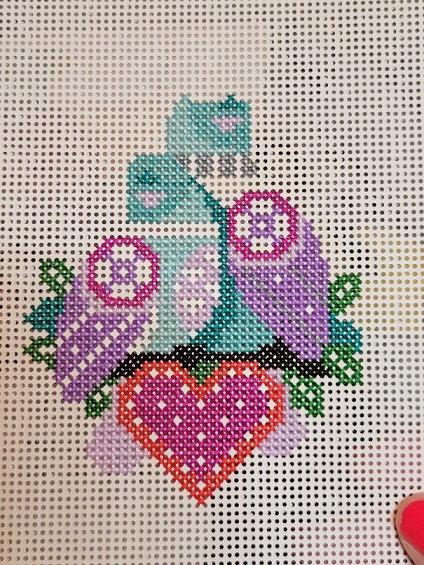
Late last year, I was delighted to see that Satsuma Street had been offering, for the last two years, an ornament pattern for the first two days. Not only do I *heart* Satsuma Street, but stitching a single 3″x4″-ish ornament felt much more achievable than the entire 12 days at once – although I also own that pattern of theirs.
Anything that starts with colours like this has to be good right?
I worked on these at a nice, leisurely pace, occasionally setting them aside if something more pressing came along, but got the beads and sequins added in time for them to go on the tree this year.
I backed them with white felt for a little extra stability, and used an iridescent white metallic thread for the hanging loops.
She already has a French hen in this year’s ornament collection, so I’m sure you can guess what’s going in my virtual cart. I’m hoping she continues with this series, because I’d love to be able to display all twelve days, eventually…just nine more years to go, at the current rate!
My true love gave to me: a calendar to count down daily!
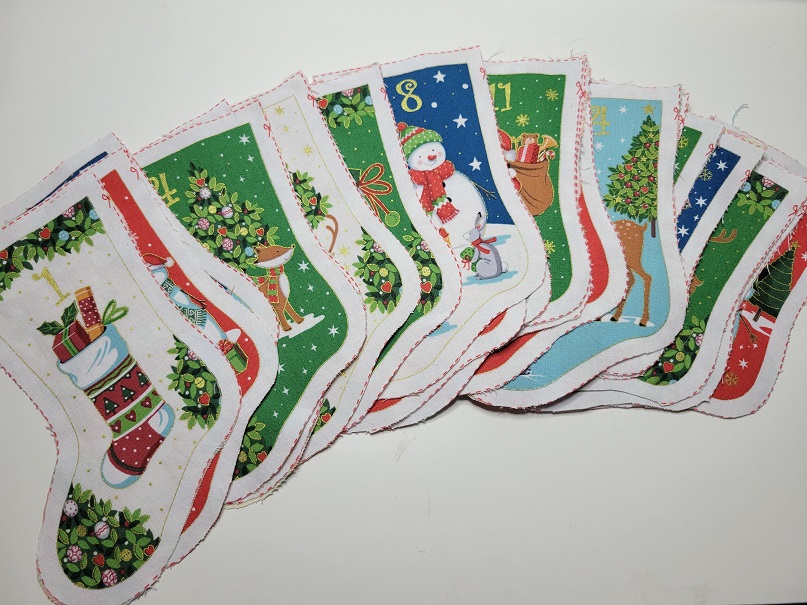
Back in the summer sometime, in the course of scrolling through Etsy, I came across a panel of 24 mini-stockings meant to be made into an advent calendar. Did I need it? No. But also maybe yes. In either case, it was delivered to me in short order. If you’re curious and/or want to try this at home, kids, it’s the “Merry Christmas Mini Stocking Advent” by Makower.
The instructions included were pretty straightforward: lay your stocking panel wrong-sides-together on top of whatever fabric you want for your stocking backs, pin and cut.
Of course, I had help.
Once they were all cut out…
…I could pin each front-back pair and sew them together.
It’s funny how much smaller they are once they’re turned right side out! From here, the instructions cheerfully directed me to press the top edge under 1/4″ and stitch close to the edge, then cut ribbon into 6″ length and fold in half and stitch the ends to the inside edge to create hanging loops. There was no way those tiny little things were going to fit around the needle plate on my machine, and I wasn’t about to hand-sew a hem. Instead, while they were inside out, I pressed that top edge the recommended 1/4″, and then turned them right side out and pressed everything – including the top edge. It still created a neat finish, and I can always sew them later if I change my mind.
Rather than deal with making ribbon loops, I decided to attach them to their display rope (that’s a very technical term) using mini clothespins. Thankfully, both the clothespins and the Command Hooks supported the weight of the chocolates I had tucked inside.
I really like that each stocking’s design is oh-so-slightly different. Even the ones that look the same have small differences!
After the day’s chocolates have been, um, dispensed with, the stocking gets re-attached, toe-up, to keep the wall from looking empty as the 24th draws closer. I’m looking forward to turning this into a yearly tradition, where the only decision is what kind of treats to fill them with.
Towel Day is still a few weeks away, but if you’re looking for a more travel-friendly option that hooks conveniently onto belt loops, backpack straps, etc., I’ve got your back. I’ve talked about making this kind of hanging hand towel before, but this time I have a step-by-step guide to walk you through the process, if you’re feeling crafty and want to try it yourself.
I started by cutting out my “topper” from my fabric of choice. I came up with (using that term very loosely) the pattern by tracing around an existing towel-top I already had.
As with most sewing projects, you want to start with your right sides together before sewing your seam. The wide (bottom) part gets left open, but you’ll sew up one side, around the peak, and down the other side.
To make it easier and less bulky when it’s time to turn these right side out, I snipped off the very tip of my point. You could also trim the seam allowance all the way around if you’re concerned, but I’ve never had a problem with it.
Et voilà! These will need to be ironed to make those edges nice and crisp. While you’re at it, fold the raw edge to the inside slightly and press it into place, too (probably 1 cm or so – just enough that you’ll be able to catch the edges when you sew it all together. I just eyeball it, because it’s pretty hard to screw these up. If these are going to be hanging as a set, you might want to work on them side-by-side to ensure you’re shortening them by the same amount).
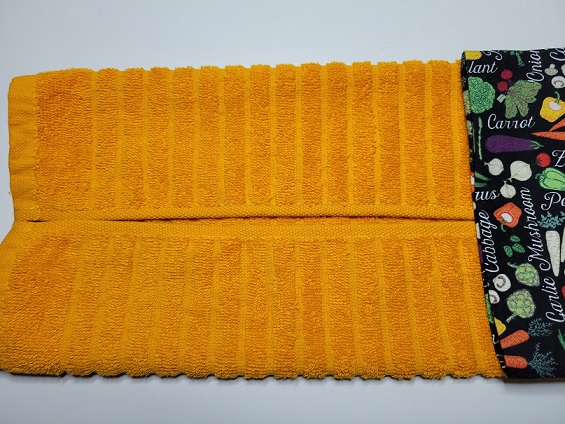
On to the towel part! Normally, I take a single hand towel and cut it in half, but I couldn’t find a hand towel in the colour I wanted, so I opted for two facecloths instead. They’re a bit shorter side-to-side than a hand towel half would be, but work well. (Not pictured: me hacking off the thick hem at the edge that’s going to go inside my topper, because no way was my sewing machine going to get through all that.)
Fold your towel (facecloth) into thirds-ish so that it looks like it will fit inside the opening of your topper. A hand towel half would have had more overlap in the middle. Clearly, I tried to test-fit this before realizing I’d need to get rid of the one hem.
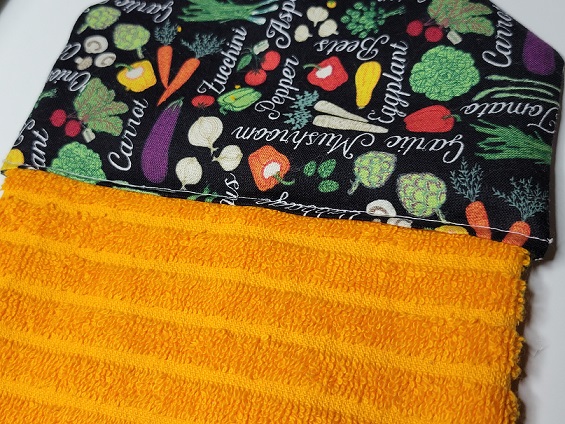
Hey, look, it fits! There’s just a little bit of extra space at the end of my topper, and that’s OK. If you’ve got more than just a little bit, try tugging on your folds gently to make your towel fill the space better. Because these were going to be hanging up as a set, I used the lines on my towel to gauge how much I had inside the topper and how much would hang down, and tried to keep both towels even. If you’re making a single one, go crazy! Well, within reason. I probably had about 2 or 3 cm of my towel up inside the topper to make sure it all got sewn together and there was no risk of it tearing out if someone were to give it a good yank. This is probably a good time to mention that if you like one side of your topper better than the other – maybe it’s got a cooler pattern placement or whatnot – figure that out now, and make that your front. I’m pretty equal-opportunity about my veggies, so however I grabbed it is how it got positioned.
Good choice making that the front, WittyChild! So many pretty colours… I sewed close enough to the folded edge of my topper that I wouldn’t have a big ol’ fabric flap flapping around and flipping up on me, but far enough away from the folded edge that both the front and back got “caught”, and I didn’t have that delightful experience of the front looking fiiiiiine while the back had a big gap where the fabric didn’t get sewn to the towel (or vice versa). If you folded up your raw edge evenly back when you were ironing all the things, you’ll be thanking yourself now. I don’t pin this into place before I start sewing; I just take it slow. Fine, I did try pinning the towel not pictured above, and broke a sewing machine needle when it hit one of the pins. There’s something to be said for my lazy-girl approach.
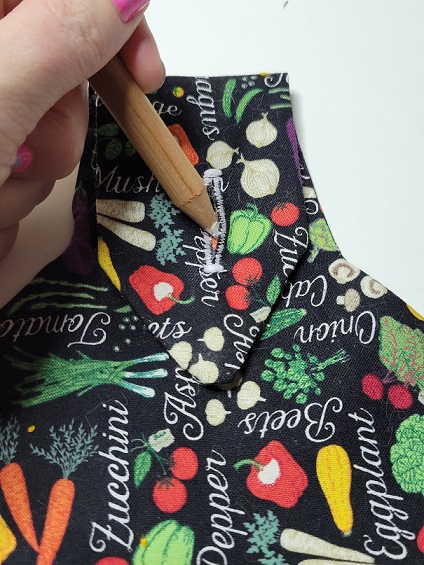
It’s time to add your buttons! I was so excited when I found these perfect orange specimens in my stash, but now think that I might have bought them with this project in mind and forgotten about them. Still! I knew I wanted my buttonhole to be near the point to allow maximum folding-over capability in case I found myself with a particularly chunky cupboard door handle at some point, and so I positioned my button where I wanted that buttonhole and then used a marking pencil (sewing pencil? Tailor’s pencil?) to mark where the top and bottom of the button are to determine how long the buttonhole needs to be.
Of course, if I had been just a little less excited about the buttons’ shiny orange-ness, I might have noticed that the card they came on had a handy measuring guide. Spoiler alert: my folksy home-remedy way of sizing worked perfectly here, too, since my buttons weren’t thick or irregularly-shaped.
It’s weird to think that buttonholes are just a series of glorified zig-zag stitches. If you don’t have a buttonhole function on your sewing machine or simply hate adding them to projects (I myself loathe sewing buttons on, but love making buttonholes. Somewhere, my sewing soul mate is out there, the one who hates the buttonhole function but loves sewing those suckers on), you could always use what the fabric store cheerfully calls “hook and loop tape”, but be it known that this stuff will eventually lose its grippy power and cause your towels to fall to the floor at the slightest provocation, such as staring at them too intently, and that’s just impractical and a little unsanitary.
Oh my stars and garters, cutting the buttonhole open once you’ve sewn it is the single most satisfying part of this whole project. It almost makes sewing on the buttons worth it.
After folding my point down to about where I’d want it, I used that marking pencil through the buttonhole to mark where my button is going to sit.
I might not like sewing them on, but I am endlessly pleased by the fact that the thread matches so well.
And there they are, ready to decorate, cheer, and dry! I keep both of them on door/drawer handles close to the kitchen sink for easy access when I need one, but they also work well on oven doors, dishwasher handles…





















 The Witty Child